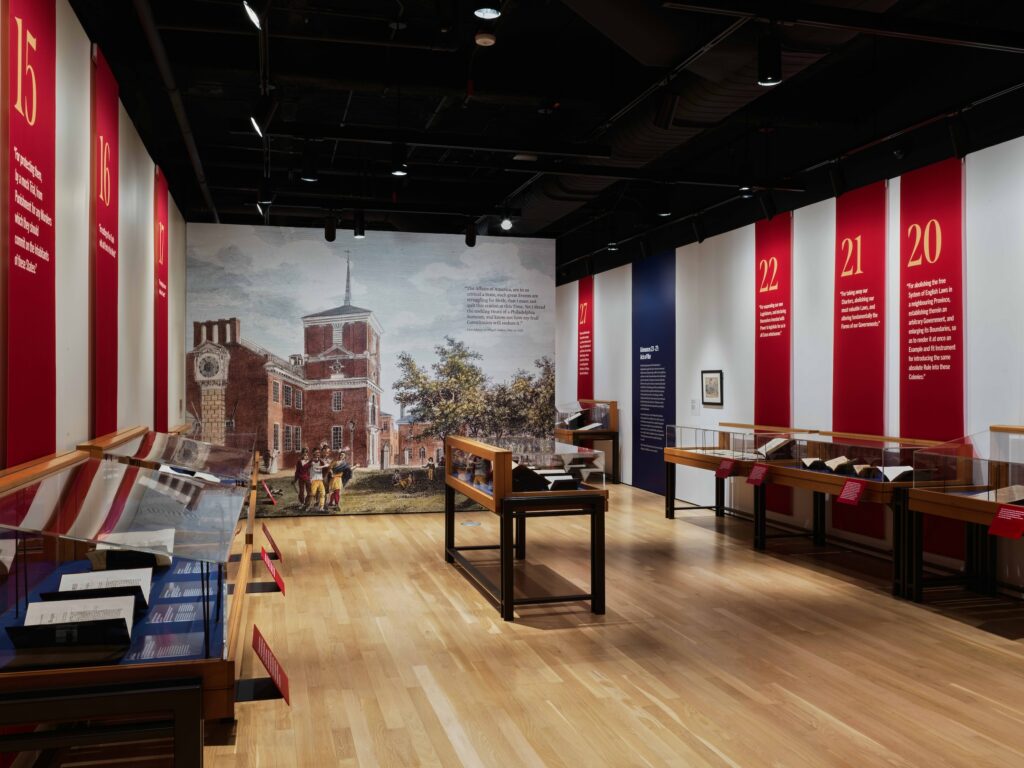
As the United States of America celebrates its semiquincentennial this Independence Day, three copies of perhaps the most coveted piece of Americana are quietly on view in New York City: The rare Dunlap Broadside, the original printing of the Declaration of Independence, written by Thomas Jefferson and adopted by the Continental Congress on July 4, 1776.
There are only 26 extant copies of the document, a large poster printed to be hung for public display. Most of the 500 copies would have deteriorated rapidly due to exposure to the elements, being folded up for transport, and other wear and tear. But you can currently catch three of the surviving originals at the New York Public Library‘s main branch, the Morgan Library and Museum, and New York University‘s Grey Art Museum.
The NYPL and the Morgan own their copies. The copy at the Grey, however, is owned by the Berkley Collection, which organized the exhibition. Collection president William Berkley, an insurance executive and NYU’s board of trustees chairman emeritus who died last month at the age of 80, began his document collection some 50 years ago. His Dunlap Broadside is one of only two still in private hands.
As you might expect, copies of our nation’s foundational document are prized among collectors of Americana and rare books and manuscripts. But while the Dunlap remains all but out of reach, the large number of other printings makes the Declaration of Independence a complicated collecting arena, with few affordable options—if any.
What Is the Dunlap Broadside?
The vote by Continental Congress to declare freedom from Great Britain followed years of rising tensions between the 13 colonies and King George III—whose offenses are outlined in the Declaration of Independence’s list of 27 grievances. (The Berkley exhibition does a great job breaking these all down.)
Having made the fateful decision to break free from the crown, the provisional government’s first order of business was to let the citizens of the fledgling nation know of this historic development by printing copies of the text to disseminate across the 13 colonies.
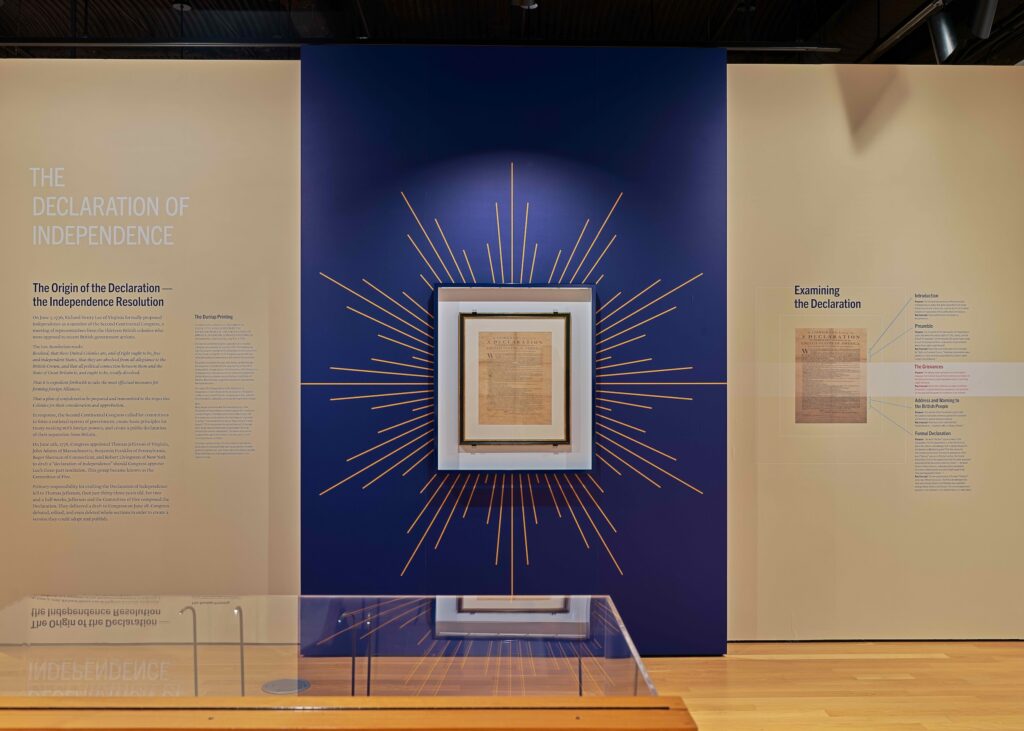
John Dunlap of Philadelphia, as the official printer to the Continental Congress, was the first to press. He immediately began printing 500 copies of the declaration as a broadside—a large, single sheet of paper printed on one side for public display—finishing the morning of July 5.
In the days and months that followed, newspaper and print shops all across the newly minted country made their own copies of the document, helping spread the news of freedom from Great Britain. In July and August of 1776, printers issued 13 broadside editions and some 30 newspaper copies. But that was only the beginning.
Congress also produced a handwritten, signed version, traveling with it while relocating to avoid the British during the Revolution. And in the wake of the War of 1812, during the Era of Good Feelings (1815–25), a trend emerged for commemorative copies, some lavishly illustrated.
At the NYPL, you can even see one of Thomas Jefferson’s handwritten copies of an earlier draft of the declaration, known as a “fair copy,” which features a passage condemning slavery excised from the final version. It’s been in the library’s collection since 1896, and is on special display for just a handful of days, with a facsimile version in the institution’s current exhibition, “Declaring America: 1776 and Beyond.”
The Holy Grail of American Manuscripts
“Anything in the book and manuscript field, what you want is primacy. What’s the first? What’s the earliest?” Selby Kiffer, a Sotheby’s senior vice president who is a specialist in the field, told me. Other than Jefferson’s draft versions, “the Dunlap Broadside is the first appearance of the text that we know as the Declaration of Independence.”
That’s what makes it so special.
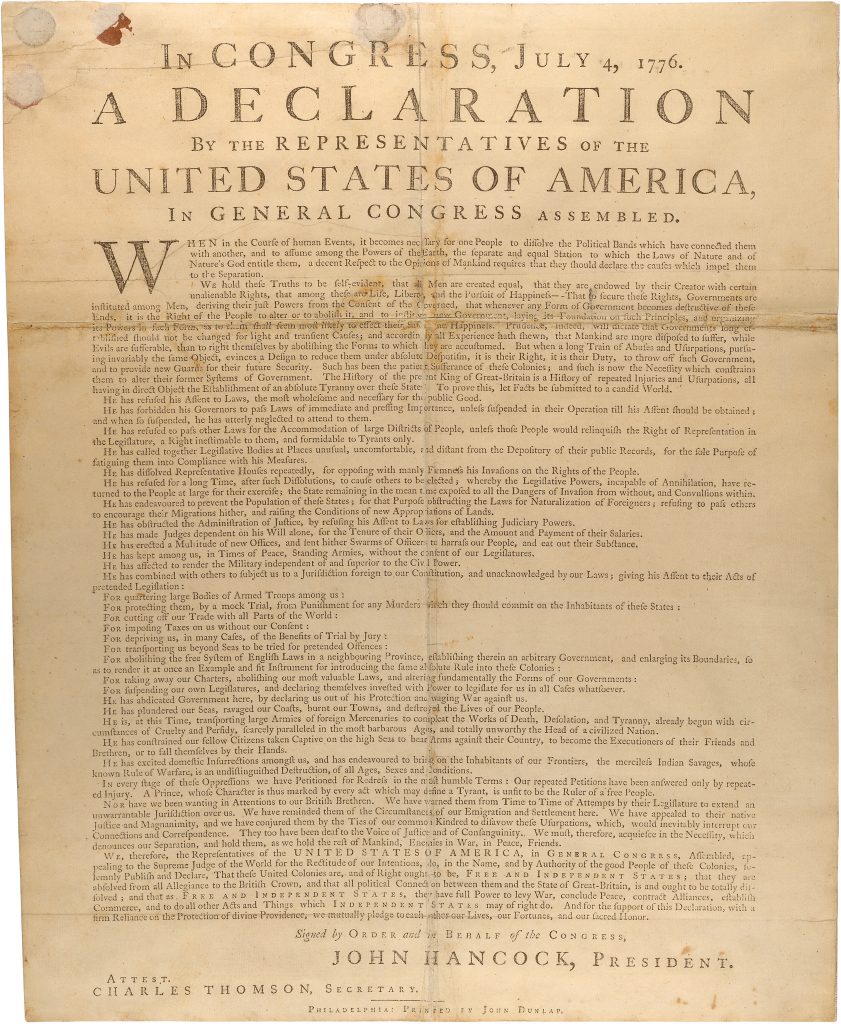
The last time an unknown Dunlap resurfaced was in 1989, when a Philadelphia man discovered it behind a flea market painting he had purchased for a mere $4. It sold at auction in 1991 for a record $2.42 million, and then again in 2000 for $8.1 million to a group of collectors headed by television’s Norman Lear.
Wikipedia still lists Lear as the owner, but according to Kiffer, Sotheby’s has since sold that copy privately for $20 million—possibly to Berkley?
Press representatives for the Berkley Collection wouldn’t share specifics about when it acquired its copy of the document, or how much it cost. But according to the New York Times, the New York Historical (as the New-York Historical Society is now known) sold the other privately held copy at some point between 1993 and 2008. That could also be the one in the Berkley Collection.
There are few true comparables, but Kiffer believes that if the Dunlap ever came to auction again, it could fetch in excess of $50 million. He based that figure on the $43.2 million sale of a rare copy of the U.S. Constitution that Sotheby’s sold to billionaire art collector and financier Kenneth Griffin in 2021, as well as his handling of that same copy’s previous sale for $165,000 in the late ’80s.
“The reason I think a Dunlap might make more than the Constitution is that at the time we sold that Constitution for $165,000, Dunlaps were making between $300,000 and $400,000 at auction,” he explained.
Printings From Across the Colonies
Today, there are only about 100 Declaration of Independence broadsides from July 1776 that are believed to have survived, including the Dunlaps. In recent years, Sotheby’s has had two high-profile sales of non-Dunlap broadsides from that month that underscore the market demand for other early printings of the document.
“The days of affordability for July 1776 printings of the declaration are over,” Kiffer said. “At a minimum, if you’re looking at either an attractive newspaper or a regional printing, you’re starting at $1 million, and could easily expect to pay $3 million to $5 million.”
In June 2024, a Declaration of Independence printed by John Holt on July 11, 1776, in the newspaper the New-York Journal, sold at Sotheby’s for $3.36 million. Holt laid out page three of the paper as if it were a broadside, giving it considerable aesthetic appeal.
The Holt Broadside was the first one to reach the people of New York, and the NYPL, fittingly, has one of the five extant copies in its current exhibition. Three others are currently on display, at the Cincinnati Museum Center; the Huntington Library in San Marino, California; and the Neuberger Museum of Art at SUNY Purchase, courtesy of the Westchester County’s archives. (Blanchard’s Auction Service in Potsdam, New York, sold the final known copy to a private collector for $1.8 million in 2017.)
And then there was the January 2025 sale of one of 10 known copies of the Exeter Broadside, printed by New Hampshire’s Robert Luist Fowle, on July 16, 1776. That sold for $2.4 million—a 158 percent increase from the same copy’s $930,000 sale at Christie’s in April 2021. And Christie’s bested that mark this January when it sold a different copy for $5.68 million.
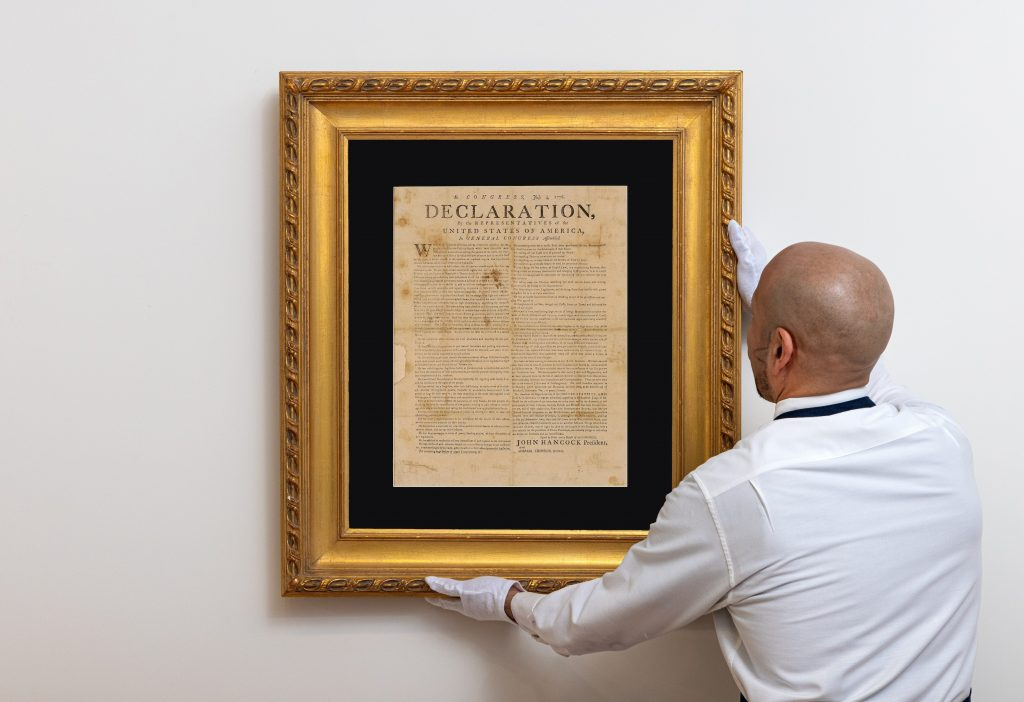
Another key version of the Declaration of Independence is the Goddard Broadside, which is the second official printing of the document, ordered by Congress in January 1777. The broadside was published by Mary Katherine Goddard, a printer and Baltimore’s first postmaster.
Compared to the Dunlap Broadside and the regional printings from July 1776, the Goddard Broadside is quite late. But it also represents two notable firsts.
It was the first printing of the document that included the names of all the signatories, making their identities publicly known, and it also was the first edition printed by a woman. Goddard took great personal risk in appending her own name to the document, and was the first woman to have her name on this foundational American text.
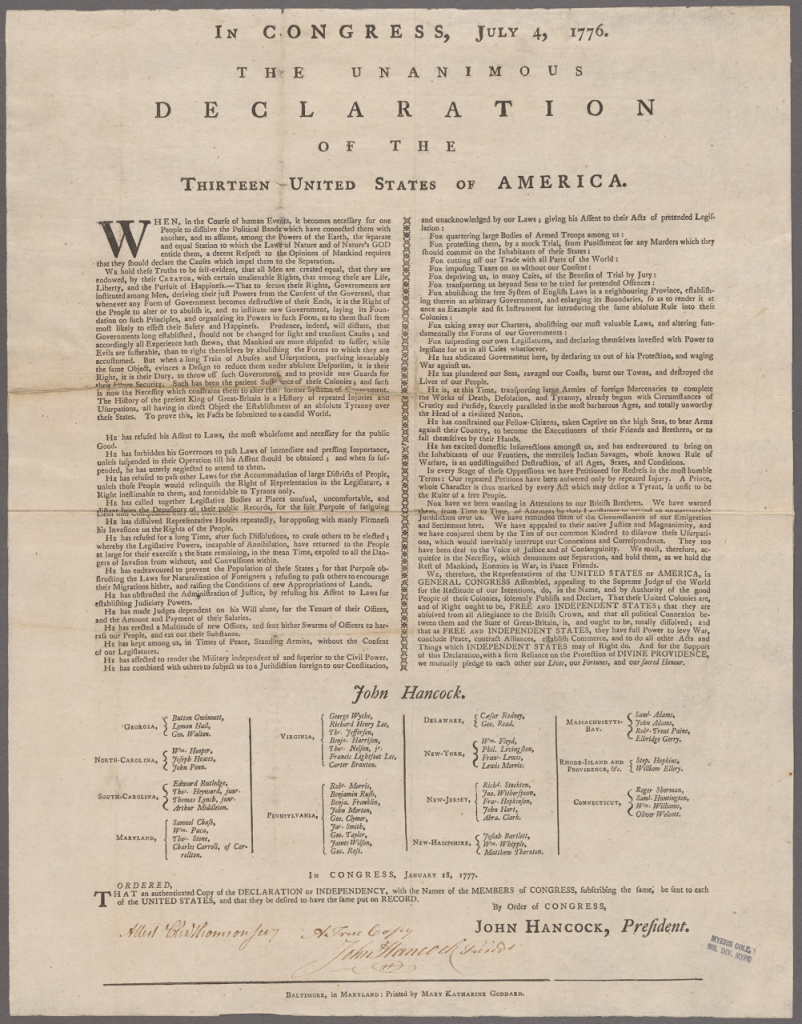
“That’s also a highly desirable copy,” Kiffer said, citing the edition’s rarity, with only nine known to have survived.
There are even mystery versions of the declaration, like an unattributed broadside owned by the New York Historical. After considerable detective work, the museum has tentatively identified the document as the work of New York City printer Samuel Loudon. It went on view for the first time ever last month, with the opening of the museum’s new Tang Wing for American Democracy.
And anniversary celebrations are only driving prices for all of these historic printings higher.
“We’re finding there is quite a swell of interest,” John Ryan, of London and New York’s Peter Harrington Rare Books, told me.
But What About the Signed Version?
In the National Archives in Washington, D.C., displayed in an aluminum and titanium casing filled with inert argon gas, sits the handwritten and signed copy of the Declaration of Independence. The name of John Hancock, the president of the Continental Congress, is written so prominently that his name has since become slang for one’s signature.
But this wasn’t the document that Congress signed the day it voted for independence. This was a commemorative copy on parchment, which Congress authorized with a resolution on July 19, 1776. Known as the engrossed or parchment copy, it is believed to have been handwritten by a clerk named Timothy Matlack and signed in a ceremony the following month—although the final signature may have been added as late as 1781.
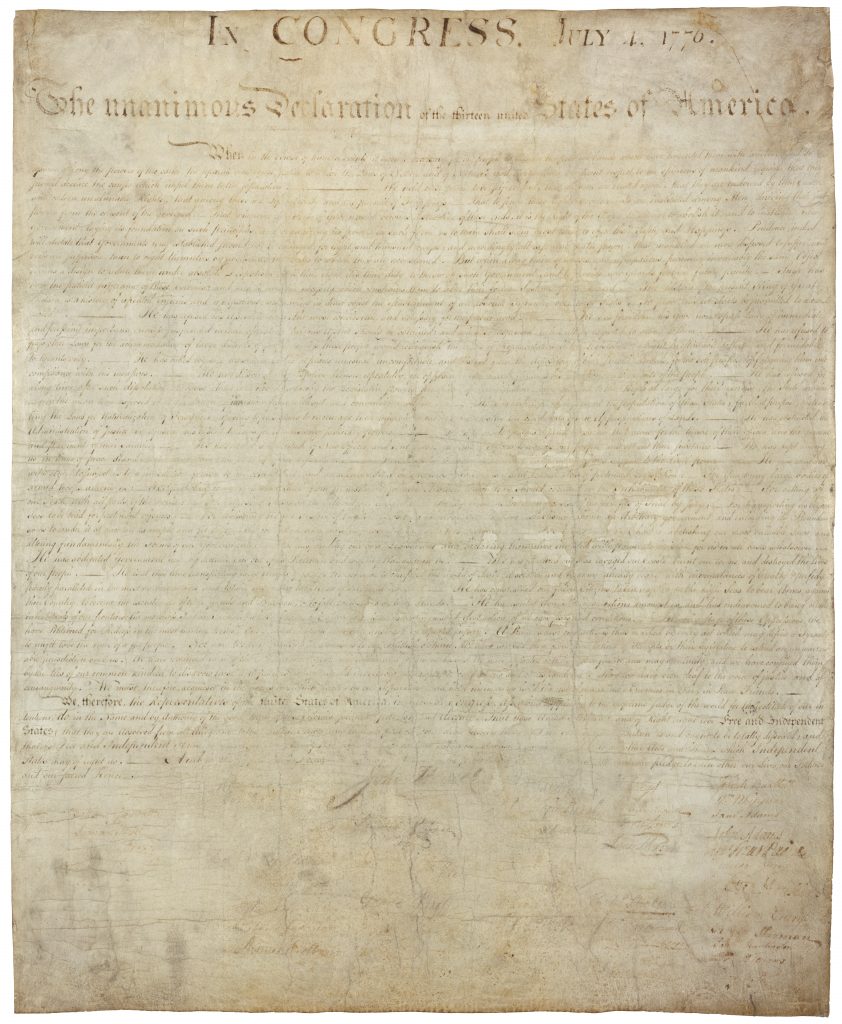
In 1820, John Quincy Adams, then secretary of state, recognized that there was a great symbolic importance to the engrossed copy of the Declaration of Independence—and that the ink on it was fading. He commissioned the printer William J. Stone to create an engraving faithfully reproducing it.
According to an 1881 report from the National Academy of Sciences, Stone used the wet-ink transfer process. That meant moistening the surface of the original document so that some of the ink could be transferred to a copper plate and etched to make 200 copies on vellum as gifts.
“It’s a very skilled piece of engraving funded by the U.S. government, and it was a high quality, expensive production,” Ryan said. “The problem is, in doing that, they damaged the original.”
If you’ve seen photos of the engrossed copy, it is almost illegible. For over 30 years, it was exposed to direct sunlight while displayed without climate control in the Patent Office building in D.C.
By comparison, the Stone facsimile, issued in 1823, looks fresh as a daisy. The government sent these reproductions to the statehouses and the surviving signatories of the declaration. Now, the 48 surviving ones have become sought after collectibles in their own right, including a rediscovered one that sold for $4.42 million at Freeman’s Auction House in Chicago in 2021.
“I’ve been at Sotheby’s a long time, and I remember when you could have one of these for maybe $35,000 or $50,000, and now they themselves trade in the range of $3 million to $5 million,” Kiffer said.
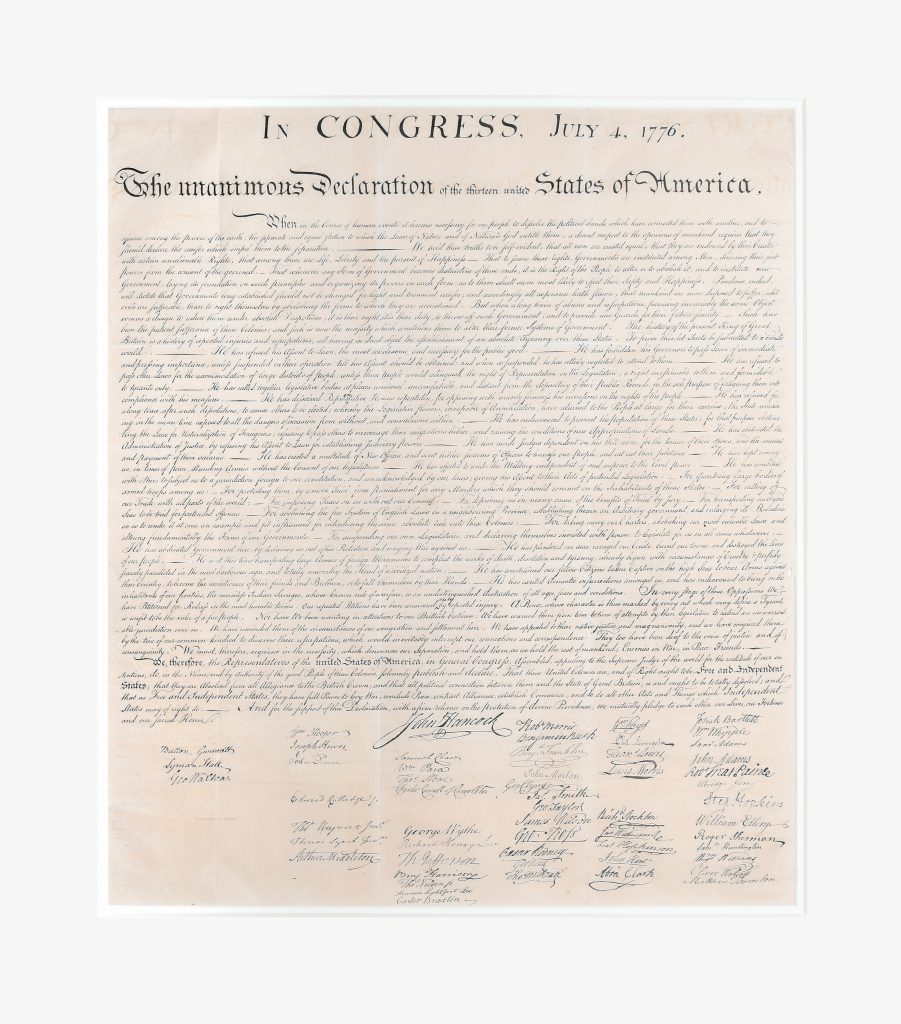
There is, however, yet another version based directly on this historic, signed copy of the nation’s foundational text. Three years after the government issued the Stone facsimile, historian Peter Force used the same plate to print a version on rice paper for his documentary publication American Archives.
Peter Harrington currently has one of those available for purchase for just $60,000, previously offered earlier this year at the Winter Show in New York and TEFAF in Maastricht.
“We had a lot of people who had no idea that it existed and were thrilled to see it and amazed that even after 200 years it can still be so so clear,” Ryan said. “It is just such an impressive and evocative display piece. This copy was made when the declaration was in a much better state of preservation and more faithfully imitates it at that stage. Now the original is completely faded and deteriorated.”
Enduring Appeal
The Stone facsimile appeared at the start of something of a renaissance for Declaration of Independence broadsides. Adams was likely inspired to commission it by two publishers, who had raced to become the first to issue a commercially available reproduction of the document.
An Irish immigrant named John Binns, the publisher of the Democratic Press in Philadelphia, began advertising his planned engraving in 1816. But his elaborately illustrated version, with medallion portraits of Jefferson, Hancock, and George Washington, as well as the official seals of the thirteen original states, took three years to finish. It was beaten to market by a cheaper rival publication by Massachusetts printer Benjamin Owen Tyler in 1818.
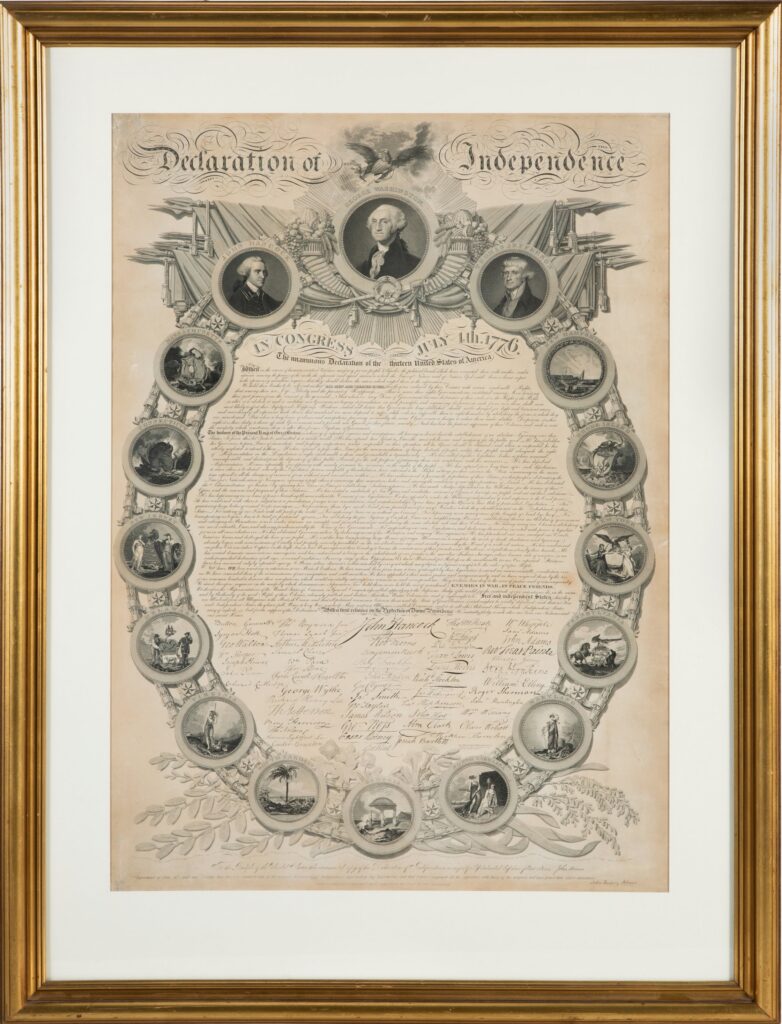
Both faithfully reproduced the signatures from the engrossed copy in facsimile for the first time, and their accuracy was certified by the State Department. And printings of both are in the Berkley exhibition.
These kinds of commercial copies, many quite decorative, remained popular through to the 1876 centennial.
“There were scores, if not hundreds of versions of the Declaration of Independence printed in that period,” said Kiffer, who himself hangs a reproduction of the Dunlap Broadside in his home study. “The idea was everyone would want one of these in their homes on display. And with those, the price points can be a few thousand to tens of thousands of dollars.”
Sotheby’s sold a copy of the Tyler facsimile printed on silk for $35,280 in January. Heritage Auctions in Dallas sold a Binns facsimile for $30,000 in 2020. On the cheaper end, you can find things like 1876 version by William H. Pratt featuring a clever calligraphy portrait of Washington, a copy that went unsold at New York’s Swann Auction Galleries with a $1,200 to $1,800 estimate in 2023.
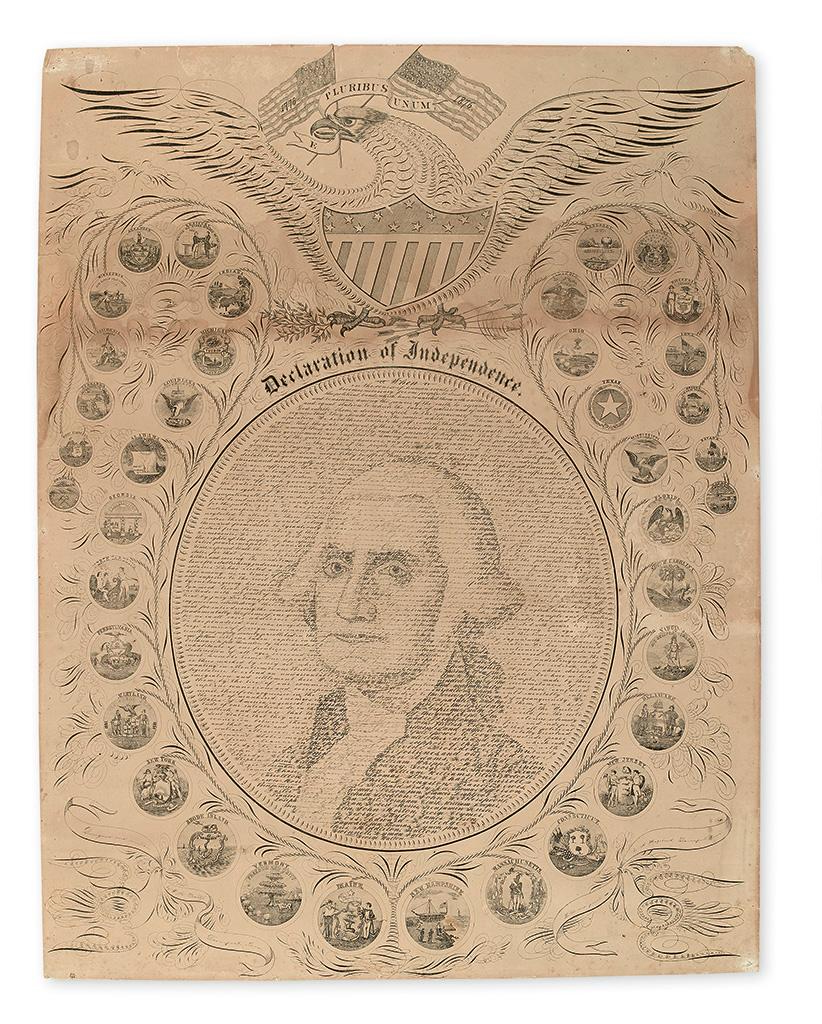
But it is the words of the declaration, not any artistic embellishment, that have made the Declaration of Independence such an important and treasured document, even 250 years after its signing. For all its faults, this is a nation founded on principles of equality and freedom—an ideal we are still working toward today.
“This is what makes us American today rather than English,” Kiffer said. “And the words remain inspirational. There was a certain element of hypocrisy in the declaration that all men are created equal when a number of the signers were slave owners. But I think that’s the aspirational aspect. It’s a statement not necessarily of what we have always been, but of what we can become.”
“The Declaration of Independence: Long Trail to Liberty” is on view at the Grey Art Museum, New York University, 18 Cooper Square, New York, New York, May 8–July 10, 2026.
“Declaring America: 1776 and Beyond” is on view at the New York Public Library, Stephen A. Schwarzman Building, Fifth Avenue and 42nd Street, New York, New York, June 15, 2026–January 10, 2027. Jefferson’s handwritten “fair copy” of the Declaration of Independence is on view July 1–7, 2026.
“The Declaration of Independence: Rare Americana from the Collection” is on view at the Morgan Library and Museum, 225 Madison Avenue, New York, New York, May 5–September 13, 2026.
“The Declaration Distributed: Westchester County’s Holt Broadside of 1776” is on view at the Neuberger Museum of Art at SUNY Purchase, 35 Anderson Hill Road, Purchase, New York, July 4–December 20, 2026.
The newly identified Loudon Broadside is on view at the New-York Historical, 170 Central Park West, New York, New York, June 18–July 5, 2026. Another July 1776 broadside, from New York City printer Hugh Gaine, is on view in “Democracy Matters,” June 18, 2026–November 1, 2026
“Declarative Acts and Revolutionary Actors” is on view at the Cincinnati Museum Center, 1301 Western Avenue, Cincinnati, Ohio, July 3–August 23, 2026.
“This Land Is…” is on view at the Huntington Library, 1151 Oxford Road, San Marino, California, June 14, 2026–January 11, 2027.
If you enjoyed this piece, please subscribe for either a free or paid subscription. Your support of independent art journalism is greatly appreciated.