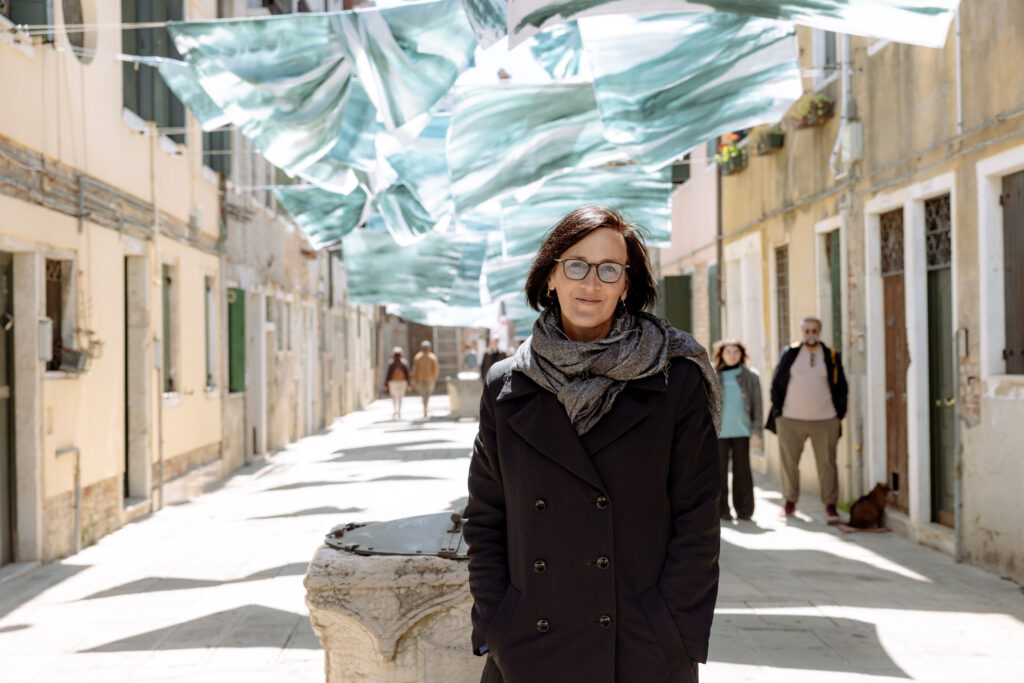
I first met Melissa McGill in 2015, when she organized an outing to the ruins of Bannerman Castle, on an island in the Hudson River, for her light art installation Constellation. In 2019, I was aboard the first test sail for Red Regatta, her ambitious public art project in the Venetian Lagoon. So when I heard she had another environmentally engaged piece on view for the opening of this year’s Venice Biennale, I booked it from the hospital emergency room—long story—to the installation. Here’s the story on her latest work!
On Corte Nova, a picturesque Venetian street crisscrossed with clotheslines, paintings on cotton bedsheets replaced drying laundry for the opening of the Venice Biennale. The project, Marea by Melissa McGill, turns art into something that lives and breathes, her watery brushstrokes flapping in the breeze, a play of light and shadow that changes based on the weather and time of day.
“I wanted there to be air, and movement, and light and sunshine,” McGill told me.
The paintings are meant to evoke the “colors and gestures of the Venetian Lagoon.” Their specific shade of blue-green is based on the many photographs the artist has taken across the city over the last 35 years. She soaked the fabric before applying the pigment, developing a wet-on-wet technique that allowed her to apply layers of diluted acrylic paint, varying her brushstrokes from sheet to sheet.
McGill has a deep relationship with Venice. She spent two years living here after college in the early 1990s, developing an abiding love for the city and its residents. In 2019, she staged one of the most memorable biennale projects in recent memory, Red Regatta, outfitting a fleet of 52 traditional Venetian vela al terzo sailboats from a local yacht club with bright red sails and sailing them across the lagoon in a series of performances.

A City Under Siege?
Venice is famously flooded with tourists—but also literally flooded. The seasonal high tide, known as acqua alta, has become increasingly frequent and severe, exacerbated by climate change, and the fact that Venice is literally sinking.
The government is taking measures to protect the city. The MOSE Project erected a high-tech system of 78 flood barriers at the entrance of the lagoon that should help keep the rising waters at bay. And a ban on giant cruise ships finally went into effect in 2021, followed by a mandatory fee for day-trippers in 2024. But McGill fears that tourist-driven motorboat traffic is still increasing, creating wakes that crash against and gradually erode the city’s stone foundations.
“It’s eating the buildings away,” McGill said.

Concern for the environment and the watershed in particular is a recurring theme in the artist’s process. McGill is also staging a small exhibition of related art just a few minutes’ walk away at 10&Zero Uno, a former butcher shop turned into a gallery by local dealer Chiara Boscolo.
Works on view include watercolor studies inspired by the colors of the Venetian waterways, and an almost unrecognizable map of the Po Delta, the river that flows into the lagoon. McGill used water to transform the map, running it under a mixture of natural colors, indigo, and chlorophyll to create a mysterious, inky composition.
“I wanted to suggest a new kind of navigation that is much more through water’s language,” McGill said.
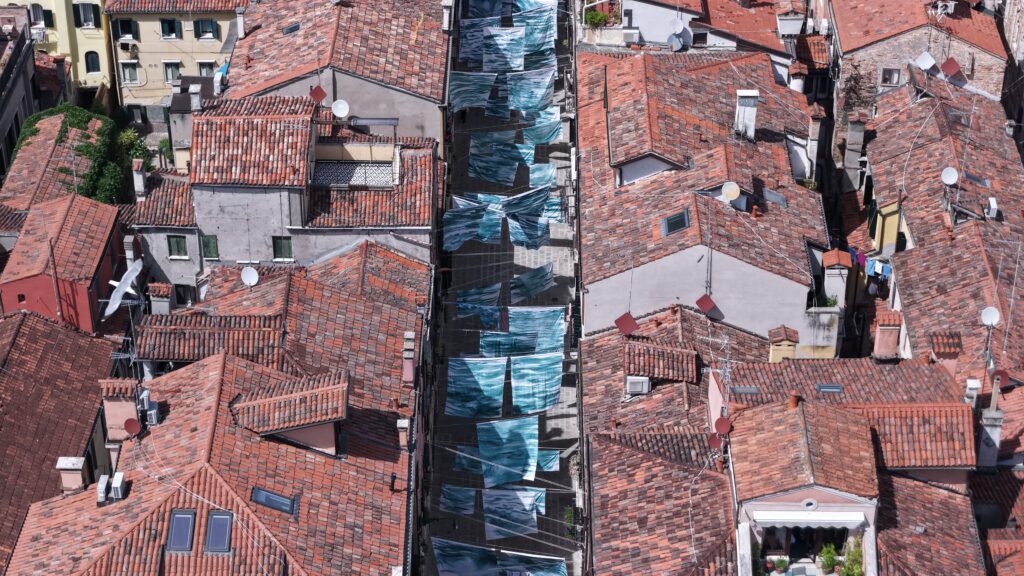
view on Corte Nova, Venice. Photo by Leonardo Mizar Vianello.
Building Community Through Art
Like Red Regatta before it, Marea speaks to the fragility of Venice, its fraught relationship with the waters upon which it is built, and issues of sustainability and environmentalism. It is also very much a collaboration with the local community, which has embraced the Beacon, New York, artist and her work to a degree rarely seen amid the contemporary art circus that descends upon the city of canals every two years.
Corte Nova has been a site of fascination for the artist since her first arrival in Venice in 1991.
McGill sees the quaint sight of tiny baby clothes, freshly washed towels, and other laundry drying in the sun as a visible sign of the real Venetians, stalwart citizens withstanding the growing tide of tourism. And the clotheslines between the houses represent a web of connections in a neighborhood that has clung to tradition even as the city has become increasingly overrun by international visitors, and endangered by the threat of flooding.
“This community are the resistors,” McGill said. “This neighborhood, Castello, is still very authentic Venice.”
But the same things that drew McGill to the street have also made Corte Nova a popular tourist destination. Turning an integral part of residents’ household routines into an art installation was a major ask.
The artist spoke with each family to figure out what would make it easiest for them to take part. Some people also have dryers, or a second clothesline on the other side of the building, and were happy to participate. Others said they could manage without hanging laundry for the 10 days the project was on view. McGill paid to replace clotheslines that were getting old, and she offered to purchase drying racks. Only a few apartments opted out, so you might spot their tops and jeans hanging alongside McGill’s paintings—a contrast that the artist actually enjoys, and which speaks to the project’s ethos.
“Many, many people told me ‘You’re never gonna do this. They’re not gonna agree to that,’” McGill told me. “But you can come together in community and creativity, actually.”
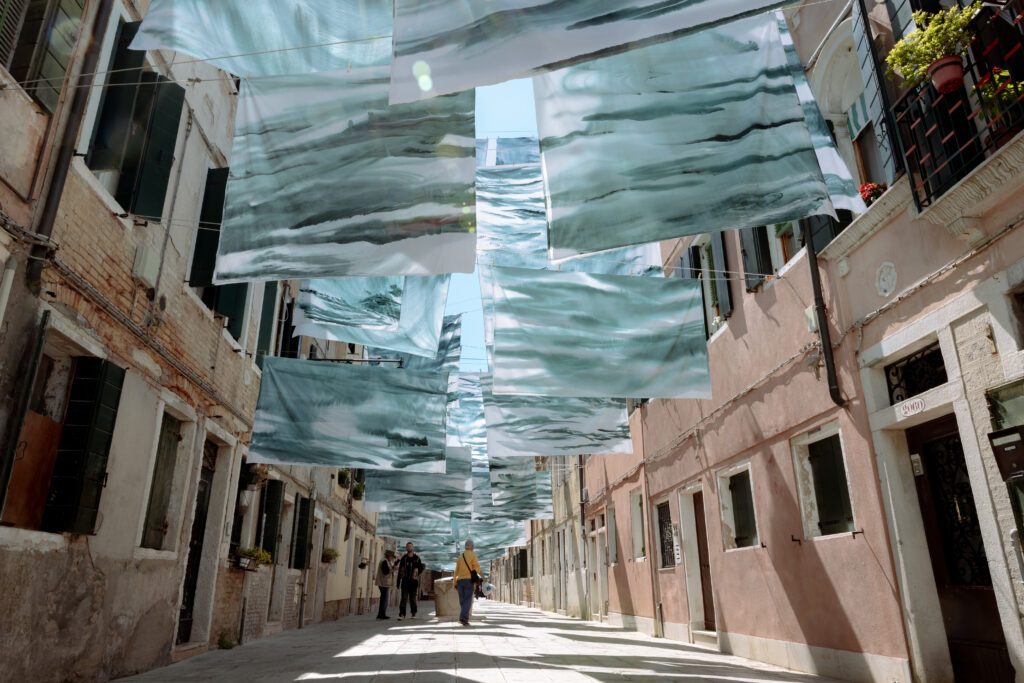
view on Corte Nova, Venice. Photo by Marta Mancuso | CIRCUIT.
Meeting the Neighbors
The project includes a forthcoming book and film meant to celebrate the residents of Corte Nova, interviewing them about their lives and family histories. As McGill spoke to me about the project, she periodically paused to greet passing locals in fluent Italian, reflecting the close relationships she has built over the course of the project.
There was Sergio, armed with a telescopic pole, who was tending to the painted sheets, untangling them from the lines after gusts of wind. McGill has also interviewed his daughter, a young woman who is determined to stay on Corte Nova and continue her family’s legacy there.
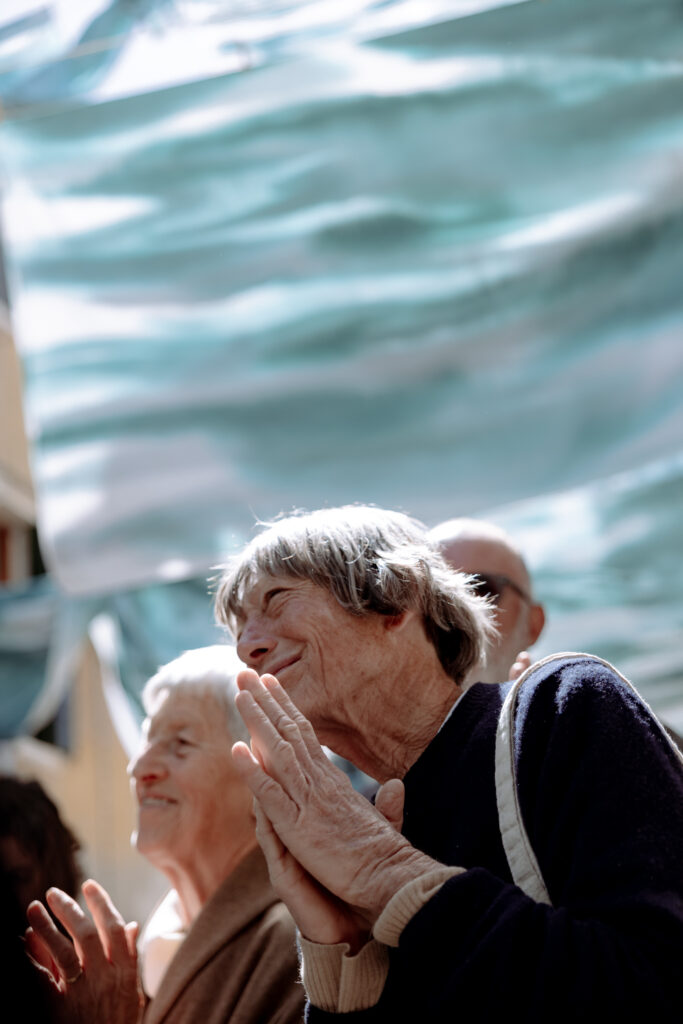
view on Corte Nova, Venice. Photo by Marta Mancuso | CIRCUIT.
An elderly woman named Maria called down from her third-story window. McGill described her as something of the unofficial Corte Nova mayor who has become very involved in bringing Marea to life, such as by lowering freshly brewed coffee in a basket to the artist and her team, which includes students from the local art and design school Università Iuav di Venezia.
Another gentleman who walked by pushing a cart was part of the city’s local branch of the communist party, located at the end of the block in a red building with a sign reading “Rifondazione Comunista Sez. 7 Martiri,” next to a shrine with a painting of Jesus. (McGill and her husband were recently guests at the organization’s four-hour Labor Day lunch, and the man had been the organizer.)

Making these kinds of connections is a vital part of McGill’s practice. But even since she began working on Marea, close to three years ago, she’s seen a noticeable uptick in the number of Airbnbs on Corte Nova, apparent from the lockboxes mounted to the doors. McGill doesn’t begrudge Venetians who want to carve out a slice of the city’s booming tourism industry for themselves, but is troubled by out-of-towners snapping up housing that once belonged to locals, potentially squeezing them out of their home city.
“The business of the biennale can become transactional, because it’s not engaging with the actual heart of the Venetians in any way,” McGill told me. “I definitely have a practice dedicated to a process of embracing all of the time and the steps and the authentic building of relationships that is essential.”
“Melissa McGill: Marea” was on view at Corte Nova, between Via Garibaldi and Fondamenta de la Tana, Venice, Italy, April 30–May 10, 2026.
“Melissa McGill: Aquae” is on view at 10&Zero Uno, Castello 1830, via Garibaldi, Venice, Italy, April 30–June 20, 2026.
If you enjoyed this piece, please subscribe for either a free or paid subscription. Your support of independent art journalism is greatly appreciated.