
Billionaire Leon Black is still on the board of New York’s Museum of Modern Art (MoMA). And for anyone who cares about the crimes of Jeffrey Epstein and his associates, the protection of women, and justice being served, this should be a problem. The latest protest calling for Black’s removal took place yesterday just down the block from MoMA, led by UltraViolet, a women’s advocacy group, alongside the Donald J. Trump and Jeffrey Epstein Bookmobile, a physical presentation of all 3.5 million Epstein files released by the Department of Justice to date.
“It’s outrageous that someone who has been credibly accused and held in contempt of Congress is sitting on the MoMA board, [at] such a prestigious institution,” Elisa Batista, UltraViolet’s campaign director, told me. UltraViolet launched its Epstein Accountability Project to hold accountable the wealthy and powerful who enabled Epstein and participated in his abuse of over 1,200 women and girls. (Few of those implicated in the Epstein files—several high-profile art world figures among them—have faced consequences for their actions, especially in the U.S.)
The push to remove Black seems all the more vital given the current lawsuit against the so-called Cornell Seven, the seven men accused of gang raping a fellow student at Cornell University in Ithaca, New York, in 2024. The school only expelled two of the men; other punishments included writing essays. The case, which has sparked widespread outrage among women and heated debate over the definition of consent, is a reminder that sexual violence has become shockingly normalized in our society. Men who abuse women are routinely allowed to retain power. A jury found our nation’s president—mentioned 38,000 times in the Epstein Files—liable for sexual abuse, yet he was still reelected.

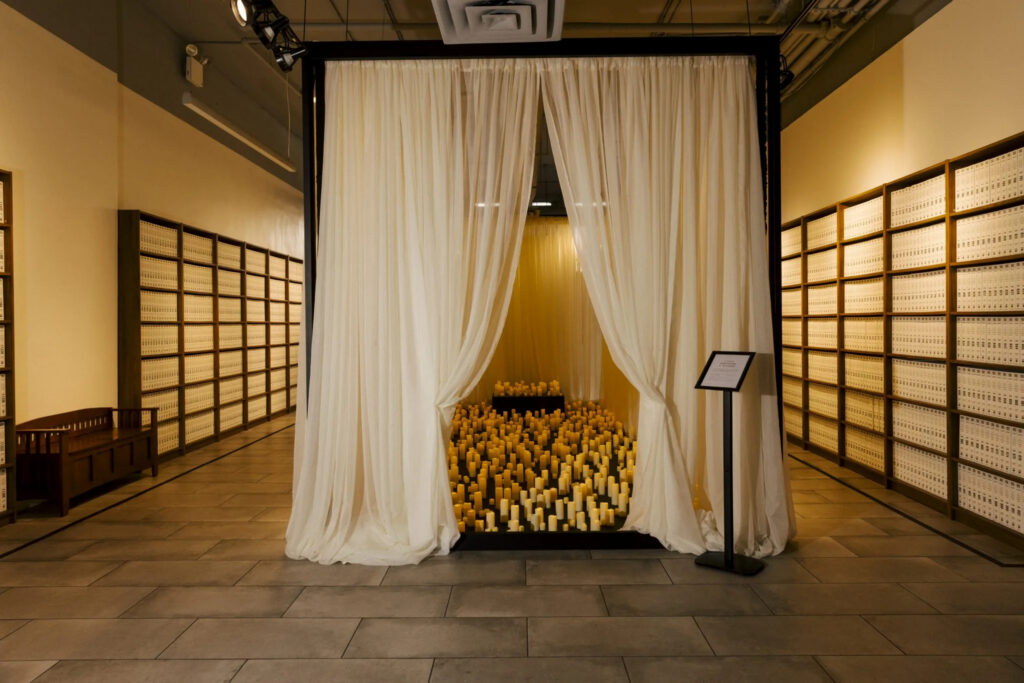
The Epstein Bookmobile is a condensed version of the Donald J. Trump and Jeffrey Epstein Memorial Reading Room, which debuted in New York in May. Together, the books weighed 17,000 pounds, displayed in bookshelves that wrapped the walls of two floors of a Tribeca gallery.
“We had this hunch that people might respond to the power of the scale, being surrounded by the evidence of what the government is ignoring,” Jenna Lowenstein, one of the organizers of the project, which is presented by the nonprofit the Institute of Primary Facts, told me.
A Shocking Display of Unimaginable Evil
Visiting the reading room was a sobering experience, heavy with the weight of Epstein’s crimes and the trauma experienced by his victims. Guests kept a respectful silence as they walked along the bookshelf-lined walls. A display of 1,400 lit candles enclosed by white curtains stood in the center of the room, a tribute to the victims that was almost like a shrine. Visitors contributed messages of anger and hope handwritten on index cards.
The bookmobile presents this all in miniature, with the addition of a special “Trump Collection” with all of the volumes that include mentions of the president and his family bound in red covers. To squeeze all 3.5 million files into a single truck, the documents have been “microprinted,” with nine files on each page—about 500 volumes, versus 3,437 for the original installation. (The books are not available for the public to read, because the DoJ did not redact all of the victims’ names, but the organizers were offering members of the press magnifying glasses if they wanted to take a look.)
The installation is housed in a converted taco truck, with timelines of Trump and Epstein’s friendship as well as allegations of sexual misconduct and assault against both men printed on the side.

The MoMA installation was accompanied by a large poster from UltraViolet, designed by Citlally Ruedas. The display detailed Black’s longstanding relationship with MoMA and his ties to Epstein, including in connection with Black’s $119.9 million 2012 purchase of Edvard Munch’s The Scream. As of press time, the museum did not respond to my request for comment.
Black’s financial dealings with Epstein amounted to payments totaling $158 million, purportedly for Epstein’s estate planning and tax advice. After that number came out in 2021, Black resigned from his company, Apollo Global Management, and did not seek reelection as chair of MoMA’s board (he remains a board member). And in connection with Epstein’s sex trafficking operation, Black paid the U.S. Virgin Islands $62.5 million in a 2023 settlement.

Over the years, Black has faced several allegations of sexual misconduct, all of which he has denied. A judge dismissed a sexual abuse case from Guzel Ganieva in 2025 because she had previously signed a $9 million NDA. Cheri Pierson, who had accused Black of raping her at Epstein’s Upper East Side mansion, dropped her lawsuit against him in 2024. A third case, from an anonymous woman who also said Black raped her at the Epstein mansion, is still ongoing despite sanctions against the plaintiff imposed in April.
A spokesperson for Black told the Art Newspaper that “to call for Mr. Black’s resignation from a board based on outright lies is the height of hypocrisy and those responsible for this campaign should be ashamed of themselves.”
Black also faces pressure from Congress. In June, he walked out of a voluntary closed-door interview with the the House Oversight Committee about his Epstein ties. On September 16, the committee voted unanimously to hold Black in contempt for refusing to sit for a deposition or to share any NDAs he had signed.

The Art of Survival
Over 15,000 visitors came to the Epstein Reading Room’s first outing, prompting an extended tour of the project that has since expanded to include a display of pastel drawings by Maria Farmer, an artist and the first Epstein victim to report his crimes to law enforcement. She met Epstein in 1995 at the New York Academy of Art, where she was a student and he was a board member—but stopped drawing for years after Epstein sexually assaulted her and her younger sister, Annie Farmer.
The new pastels in the bookmobile are at first glance colorful and skillfully rendered, but they are actually quite difficult to look at. Each one radiates a deep trauma, a pulsating evil that was allowed to operate with impunity.
In one drawing, a young blonde girl in a schoolgirl’s plaid skirt is restrained by a man who covers her mouth with his hand. A book in the corner of the picture, which reads “Epstein & Waco by Louis Freeh,” points to the man’s identity. Louis Freeh became the director of the FBI shortly after the deadly Waco siege of 1993, and was in charge when Farmer reported Epstein to the agency in 1996. But the FBI did not pursue the investigation, and Epstein continued to prey on women and girls for years.

The work’s message is clear: The government silenced Farmer. The painting may be a self portrait, or perhaps a depiction of her younger sister. Either way, the horror and disgust is apparent in the poor girl’s eyes. It is heart-wrenching.
Farmer is also working on her own version of the tarot called “Epstein’s Deck.” The four works on view in the bookmobile included what appeared to be billionaire collector Les Wexner, Epstein’s biggest client, standing over the prone body of the blind folded figure of justice. (Farmer has alleged Epstein raped her at Wexner’s home.) Epstein himself, naturally, has his own card as “The Hanged Man.”
“For Maria to pick up the pastels again, and do all these amazing works… Art heals always,” Epstein survivor Dani Bensky said. She told me she was an aspiring ballerina when she met Epstein, and, like Farmer, temporarily was unable to pursue that passion. But today, she works as a dance instructor, and believes that “movement and dance have saved my life more times than I can count.”

Moving Forward
Connecting with other Epstein survivors has also been a means of healing for Bensky. Since last year, she has been part of the Survivor Sisters group, working to promote transparency about the abuses perpetrated by Epstein and his network while seeking truth, justice, and healing.
“We could see the depth of each other’s pain, and it was an immediate bond, and an immediate family. We lived in so much isolation before this, where each one of us was feeling our own shame and our own heaviness,” she said.
In the lead-up to the midterm elections next month, which will decide which party controls Congress, the bookmobile and the reading room will both be on the road—the truck is next headed to Manchester, New Hampshire, and the reading room is currently in Columbus. By the time the polls close, the reading room will have made it to seven cities, with about 24 stops for the bookmobile, all culminating in an election night event with survivors in Palm Beach, where Epstein lived and conducted many of his crimes.

“We’re a nonprofit, not a political project, because we don’t think that the abuse of children should be a partisan issue,” Lowenstein said. “Everyone should vote this fall, and everyone who goes into a polling place should do it keeping in mind the thousands of women and girls who were abused and victimized by Jeffrey Epstein and his criminal network, and the government’s inaction.”
Only about 15 of Epstein’s many victims are publicly fighting to arrest, charge, and prosecute Epstein’s associates—and to enact lasting structural societal change that will prevent similar assaults on women and girls in the future. The pursuit of justice is not easy. But Bensky and other activists won’t give up.
“I have to believe that the dam breaks at some point,” Bensky said. “They can’t do this forever.”
Response
Thank you for covering this important story